Central Florida buyers are asking sellers to help them close. In its July 2026 report, the Orlando Regional REALTOR Association said 68% of REALTORS® it surveyed are seeing more seller concessions than a year ago. The same survey found 64% watching buyers wait for mortgage rates to drop.
That second number explains the first. Freddie Mac's October 8, 2026 survey put the 30-year fixed at 7.40 percent. Buyers from Winter Garden to Clermont now hit a payment wall before they ever object to a price.
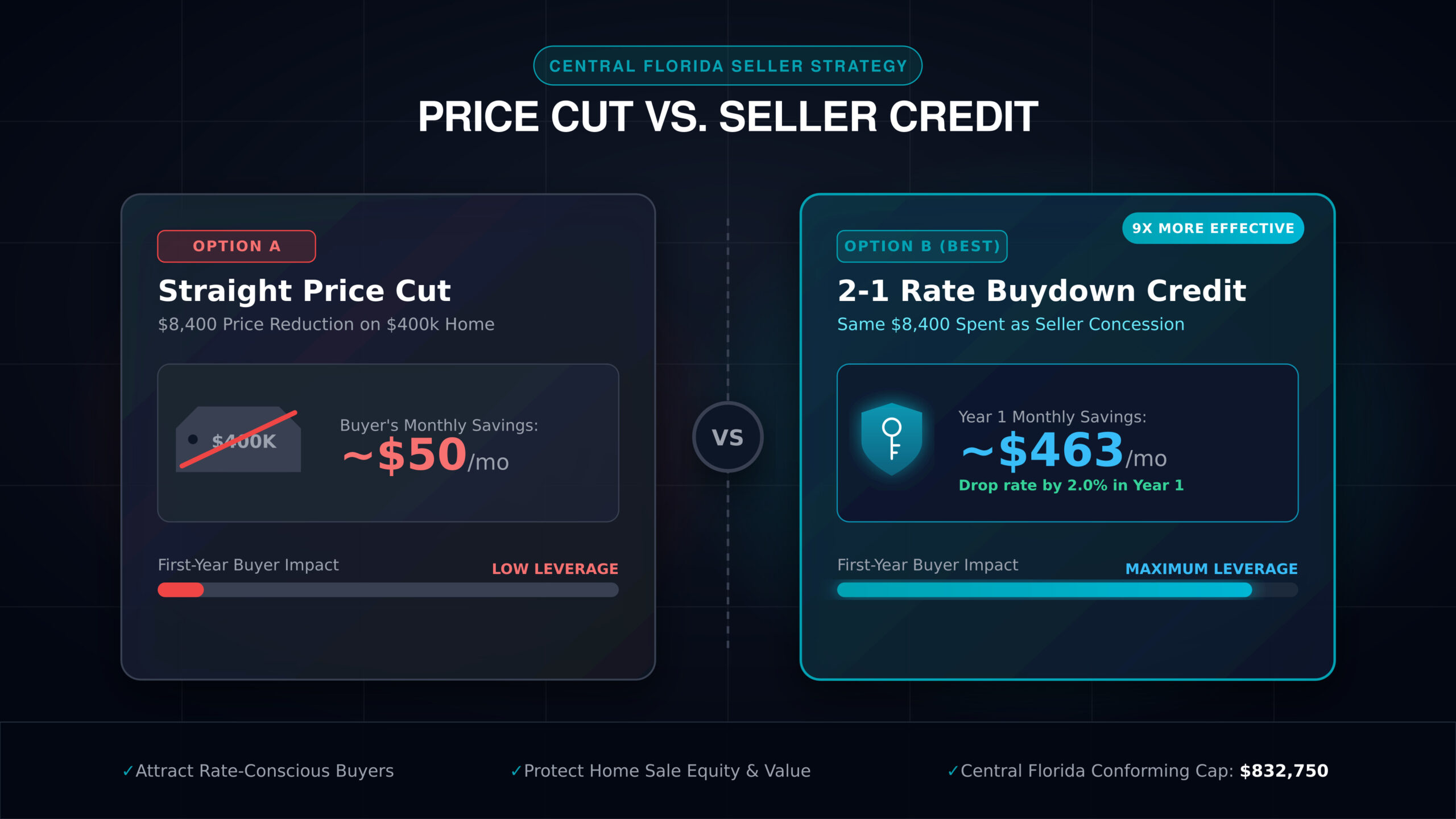
The right concession costs a seller far less than most people assume. On a $400,000 home, about $8,400 in seller money cuts the buyer's payment by $50 a month as a price reduction. Spent on a 2-1 rate buydown, that same $8,400 cuts the payment by $463 a month in year one.
At a glance
Dollar for dollar, a seller-paid 2-1 buydown delivers about nine to ten times more first-year payment relief than a price cut.
Orange, Osceola, Lake, and Polk counties all carry a 2026 conforming loan limit of $832,750, which keeps most local buyers under Fannie Mae's concession rules.
Florida charges buyers documentary stamps and an intangible tax on their mortgage, and a seller credit can pay both.
Because Florida property taxes are paid in arrears, the tax proration credit at closing sits outside the concession cap.
What Are Seller Concessions, and What Can They Pay For?
Seller concessions in real estate are costs a seller agrees to cover for the buyer, usually written into the contract as a seller credit. Some agents call it a seller assist or a seller contribution. Lenders use the term interested party contribution, since the money comes from someone with a stake in the sale.
The credit can cover the buyer's closing costs and prepaid items, such as the first year of homeowners insurance. It can also buy points that lower the interest rate. It cannot go toward the down payment. Fannie Mae's Selling Guide blocks interested party money from the down payment and from the cash reserves a buyer has to show.
A credit also cannot run larger than what the buyer owes at closing. If a seller agrees to $15,000 and the buyer's real costs come to $11,000, the buyer does not pocket $4,000. The lender treats the extra as a price reduction, or the two sides rewrite the contract to match.
How Do Seller Concessions Work in a Florida Closing?
A concession starts in the purchase contract and ends on the settlement statement. The buyer requests it in the offer or in negotiation. Once both sides settle on a figure, the buyer's lender confirms it fits the loan's rules.
The title company or closing agent then applies the seller credit at closing, subtracting it from what the seller would otherwise receive. Sellers often ask whether concessions come out of pocket. Most sellers never write a check. The credit comes out of the proceeds instead.
The 2-1 Buydown Math on Three Central Florida Homes
We tested three price points. At every one, a seller-paid 2-1 buydown gives the buyer about nine to ten times more first-year relief than an equal price cut. The buyer's rate starts two points lower, rises one point after year one, and reaches the full rate in year three.
The table uses a round 7.0 percent rate to keep the math clean, so treat it as an illustration and not a rate quote. Payments show principal and interest only. The seller's cost equals the payment difference the buydown covers across 24 months.
| Entry price | Mid price | Upper price | |
|---|---|---|---|
| Purchase price | $400,000 | $650,000 | $1,200,000 |
| Down payment | 10% | 20% | 20% |
| Loan amount | $360,000 | $520,000 | $960,000 |
| Loan type in Central Florida | Conforming | Conforming | Jumbo |
| Monthly payment at 7.0% | $2,395 | $3,460 | $6,387 |
| Year 1 payment at 5.0% | $1,933 | $2,791 | $5,153 |
| Year 1 savings per month | $463 | $668 | $1,233 |
| Year 2 payment at 6.0% | $2,158 | $3,118 | $5,756 |
| Year 2 savings per month | $237 | $342 | $631 |
| Seller's cost for the 2-1 buydown | $8,391 | $12,120 | $22,376 |
| Monthly savings if that money cut the price | $50 | $64 | $119 |
| Seller's cost for a 1-0 buydown | $2,840 | $4,103 | $7,575 |
| Concession limit (conventional loan) | $24,000 | $39,000 | Set by lender |
The entry-price home sits right at the Orlando-area median of $400,676 that the Orlando Regional REALTOR Association reported for August 2026. For less than $8,400, the seller turns a $2,395 payment into $1,933 for the buyer's first year.
The mid-price home has room to spare. Plenty of it. With 20 percent down, the buyer can receive up to $39,000, and the 2-1 buydown uses under a third of that limit.
At the upper price, the $960,000 loan crosses the $832,750 conforming limit. That makes it a jumbo loan, and the buyer's jumbo lender decides how large a concession it will accept. Before a home at this level lists, our Windermere real estate agents walk the seller through concessions as one option to weigh in today's market. Once an offer arrives, ask the buyer's lender what it will allow.
Know one limit before you count on a buydown. Fannie Mae requires lenders to qualify buyers at the full note rate, so a temporary buydown never stretches how much someone can borrow. It softens the first two years instead, when new owners are buying furniture and handling the small repairs every house needs. Freddie Mac put the average 30-year rate at 7.40 percent on October 8. At that rate, both the savings and the seller's cost run about 2 percent above the table.
Seller Credit vs. Price Reduction in Florida
A price reduction lasts the life of the loan, while a 2-1 buydown runs out after two years. Given enough time, the price cut pulls even. In the three examples above, the cut's monthly savings match the buydown's total value somewhere between 14 and 16 years.
A price cut also trims the buyer's down payment. On the mid-price home, a $12,100 reduction saves the buyer $2,420 at closing, which matters to someone stretching to reach 20 percent.
Florida's deed stamps give the price cut one more small edge. Because the deed tax runs 70 cents per $100 of price, cutting $30,000 saves the seller $210 in Florida documentary stamp tax. Florida law ties that tax to the consideration paid. The statute is silent on whether a seller credit lowers it, so ask your title company how it will treat one.
Our view is that most buyers today care more about the first few years than the fifteenth. A buyer worried about rates wants help now. We still recommend a price reduction when a home sits above what recent sales support. No credit can rescue a list price the appraisal will not reach.
Who Pays Closing Costs in Florida?
By Florida custom, the seller pays documentary stamp tax on the deed, and the buyer pays the two taxes tied to a new mortgage. Each one stays negotiable in the contract, and a seller concession is the usual way a seller picks up part of the buyer's share.
| Tax | Rate | Amount | Customarily paid by |
|---|---|---|---|
| Documentary stamp tax on the deed | 70 cents per $100 of price | $2,800 | Seller |
| Documentary stamp tax on the mortgage | 35 cents per $100 of loan | $1,260 | Buyer |
| Florida intangible tax | 2 mills (0.2%) of loan | $720 | Buyer |
Florida documentary stamp tax applies twice in a typical financed sale, once on the deed and once on the mortgage. Doc stamps on the mortgage and the Florida intangible tax only exist because the buyer is borrowing, so a cash buyer skips both. On this purchase, the financed buyer owes $1,980 for those two items before any title or lender fees.
That makes them an easy target for seller-paid closing costs. Picture the entry-price home again. A 2-1 buydown at $8,391 plus the buyer's $1,980 in mortgage taxes adds up to $10,371. The conventional cap on that loan is $24,000, so the seller has covered both and still used less than half the allowance.
For the rest of the fees a buyer faces, our breakdown of how much closing costs run in Florida walks through each line.
Florida's Property Tax Credit Sits Outside the Cap
Florida property taxes are paid in arrears, and that works in the seller's favor at closing. State law makes each year's taxes due November 1 and delinquent the following April 1. The bill for a year arrives after most of that year has passed.
When a home sells mid-year, the seller has not yet paid that year's taxes. The settlement statement fixes this with a proration credit to the buyer for the months the seller owned the home. Fannie Mae's rules state that a legitimate tax proration credit like this is not an interested party contribution. It never eats into the concession limit, so sellers can plan their concession without subtracting it.
Want Your Concession Options Priced Out?
Our agents run each concession structure against your list price before your home hits the market, so you see exactly what it costs you and what it does for a buyer's monthly payment.
Maximum Seller Concessions by Loan Type
The buyer's loan program sets the maximum seller concession, and the limits range widely. A conventional loan allows anywhere from 2 percent on an investment property to 9 percent for a buyer putting 25 percent or more down.
| Loan type | Property type | Down payment | What the credit can cover | Maximum seller concession |
|---|---|---|---|---|
| Conventional | Primary or second home | Under 10% | Closing costs, prepaid items and discount points | 3% |
| Conventional | Primary or second home | 10% to 24.99% | Closing costs, prepaid items and discount points | 6% |
| Conventional | Primary or second home | 25% or more | Closing costs, prepaid items and discount points | 9% |
| Conventional | Investment property | Any | Closing costs, prepaid items and discount points | 2% |
| FHA | Primary home | Any | Closing costs, prepaid items, discount points, rate buydowns and upfront mortgage insurance | 6% |
| VA | Primary home | N/A | Normal closing costs | No cap |
| VA | Primary home | N/A | Prepaid items, funding fee, rate buydowns and paying off the buyer's debts | 4% combined |
| USDA | Primary home | N/A | Closing costs and other costs paid for the buyer | 6% |
| Jumbo | Varies | Varies | Set by the buyer's lender | Set by lender |
FHA seller concessions top out at 6 percent of the sales price, no matter how much the buyer puts down. VA seller concessions follow their own logic. The VA sets a 4 percent limit based on its reasonable value for the home. That limit covers extras like the funding fee or a rate buydown, while normal closing costs fall outside it.
Conventional limits use whichever is lower, the contract price or the appraised value, so a low appraisal shrinks the room. The 3 percent tier is the one to watch. A buyer putting 5 percent down on a $400,000 home can receive no more than $12,000. Promise $18,000 in a counteroffer and someone has to solve a $6,000 gap before closing.
Seller-paid buyer agent commissions follow separate rules. FHA, VA, Fannie Mae, and Freddie Mac exclude reasonable and customary commissions from their concession limits. USDA currently counts them toward its 6 percent cap, and its proposed change to that rule remained unfinished as of October 2026.
Why the Cap Is Predictable in Orange, Osceola, Lake, and Polk Counties
All four counties the Erica Diaz Team serves share identical 2026 loan limits. That uniformity makes concession planning simpler, because one set of numbers covers the whole service area.
| County | Conforming limit | FHA limit |
|---|---|---|
| Orange | $832,750 | $541,287 |
| Osceola | $832,750 | $541,287 |
| Lake | $832,750 | $541,287 |
| Polk | $832,750 | $541,287 |
A buyer near the Orlando-area median borrows well under $832,750, so Fannie Mae's tiers apply without surprises. For most listings our Clermont real estate agents and Davenport Realtors handle, the buyer's down payment alone tells you roughly how much concession room exists.
The exception sits at the top of the market. Once a loan passes $832,750, the buyer moves into jumbo financing, and each jumbo lender writes its own limit. FHA buyers carry their own ceiling as well, since their loan cannot exceed $541,287 in any of the four counties.
Five Ways to Structure a Concession Offer
Seller concessions for closing costs are the most common structure. You keep the full price, add a closing cost credit, and the buyer brings less cash. A seller-funded mortgage rate buydown at full price works the same way, except the help lands in the monthly payment. The seller can buy down the interest rate for two years with a 2-1, or for the life of the loan with discount points.
Size the buydown before you offer it. A 1-0 buydown is the smallest offer worth making. On the entry-price home it costs $2,840 and takes a full point off the buyer's first-year rate. The 2-1 costs about three times as much and roughly doubles that first-year relief.
We like giving buyers a choice. Offer one dollar amount and let the buyer divide it between closing costs and a rate buydown. A buyer short on cash puts it toward closing, while a buyer focused on the payment puts it toward the rate.
After an inspection, a repair credit can replace a repair, which saves you from coordinating contractors during escrow. Confirm it with the buyer's lender first, because lenders do not all handle repair credits the same way. A credit can also reward a fast closing when your own move depends on the timing.
Some buyers ask for a higher price with a credit back. It nets out close to even, though a higher price raises your deed stamps and any fee calculated on the sale price. The home also has to appraise at the higher number, since conventional limits follow the lower of price or appraised value.
When offers stack up, compare them by what you net. A $410,000 offer asking for a $10,000 credit nets the same as a clean $400,000 offer. A clean $405,000 offer beats them both by $5,000.
One kind of sweetener can backfire. Fannie Mae treats furniture, vehicles, moving costs, and cash gifts as sales concessions and subtracts their value from the price for underwriting. Leaving the golf cart in the garage can quietly reduce what the buyer can borrow.
Competing With Central Florida Builders
Resale sellers across Central Florida compete with new construction, and builders lean on incentives. Nationally, 66 percent of builders used sales incentives in September 2026 and 38 percent cut prices, according to the NAHB/Wells Fargo Housing Market Index.
Buyers touring model homes in Lake County see advertised rate buydowns, then visit your listing expecting something similar. A funded 1-0 or 2-1 buydown lets a resale home answer the builder's pitch directly. When a seller is open to a concession, our Minneola real estate agents usually build it into the asking price before the home lists.
Promote the buydown carefully. Federal truth-in-lending rules treat any payment amount in an ad as a trigger term. Using one forces disclosure of the down payment, the repayment terms, and the APR. A line such as "seller-paid rate buydown available" avoids that requirement, so save specific payment figures for conversations with a lender involved.
Timing matters too. Offer the concession first and hold the price reduction in reserve. If the home does not move, you can still cut later. Either way, your list price stays intact during the first weeks on the market.
Are Seller Concessions Tax Deductible in Florida?
For buyers, seller-paid points can be deductible, and for sellers, certain loan charges reduce the taxable gain. Florida itself adds no state tax on top.
IRS Publication 936 treats discount points paid by the seller as if the buyer paid them. A buyer who meets the IRS tests can deduct them, and must lower the home's tax basis by the same amount. The seller cannot deduct those points as interest.
On the seller's side, IRS Publication 523 lists loan charges a seller pays on the buyer's behalf as selling expenses. Those reduce the amount realized from the sale and, with it, any taxable gain. Most owners can exclude up to $250,000 of gain on a main home, or $500,000 for married couples filing jointly. Owners with large gains, such as long-time owners in Winter Park or Windermere, should review a concession with a tax professional.
Florida does not tax residents' personal income, a limit written into the state constitution, so a gain on your home faces federal rules only.
Before You Sign a Counteroffer
Find out the buyer's loan type before you agree to a dollar figure. An FHA buyer and a jumbo buyer face very different limits. Guess wrong and the mistake surfaces at underwriting.
Be wary of raising the price just to fund a credit, since the appraiser decides whether that works. Keep personal property out of the deal for the underwriting reason above. And keep monthly payment figures out of your marketing unless the required disclosures go with them.
The Erica Diaz Team educates sellers on concessions before listing. Not every situation calls for one. When a seller is open to it, our agents help build a strategy around it. Our team has earned more than 800 five-star reviews and a 5.0 rating on Google. We rank in the Top 1% in Florida, and the Orlando Business Journal has recognized our work. Learn more about selling a home in Central Florida with our team. You can also see homes our team recently sold across the area.
Plan Your Concession Before Buyers Ask
The Erica Diaz Team sizes each concession to the buyer's loan and keeps it inside the limit, so nothing falls apart at underwriting. Start at ericadiazteam.com or call the team today.
Sources and disclaimer: Concession limits and buydown rules: Fannie Mae B3-4.1-02 and B2-1.4-04, FHA, VA, USDA (proposed rule). Loan limits: FHFA 2026, county figures via FHFA and HUD data. Market data: Orlando Regional REALTOR Association, Freddie Mac, NAHB. Florida taxes: s. 201.02, s. 201.08, s. 199.133, s. 197.333, Fla. Const. art. VII, s. 5; customary payer per Barnes Walker. Federal tax: IRS Publications 523 and 936. Advertising: 12 CFR 1026.24. Payment examples use a hypothetical 7.0 percent rate and show principal and interest only. Market figures reflect the periods shown, and loan limits update each year. This article is not legal, tax, or lending advice; confirm current rules with the buyer's lender, your title company, and qualified counsel.