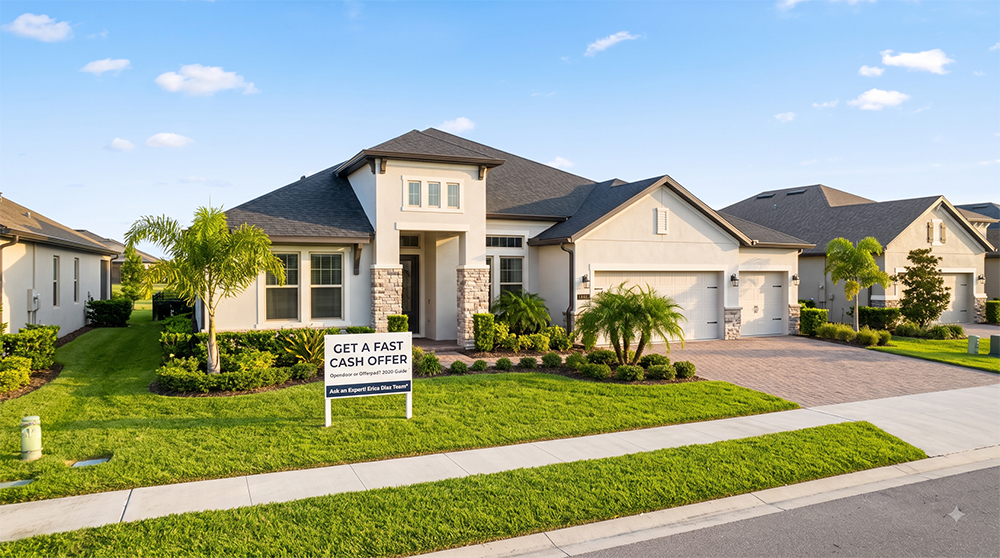
Both companies buy homes for cash across Central Florida in 2026. Neither one is simply better than the other. They fit different sellers. The fee you pay depends on which one you pick and what shape your home is in. Here is how they actually compare, using each company's own numbers.
How does each company actually work?
Opendoor gives you one path. Request an offer, get a number within 24 hours, and close in 21 to 60-plus days on your schedule. There is no listing, no showings, and no repairs required before closing.
Offerpad gives you a choice instead of one path. You can take a direct cash offer, just like Opendoor. You can also choose a "Hybrid Cash Offer." That option locks in a guaranteed cash number. It still lets you try listing the home for a higher price afterward. A third option lets you list with an Offerpad agent and use the cash offer only as a backup. Offerpad can close in as little as 7 to 8 days, or you can push it out to 60 days.
What does each option actually cost?
Offerpad publishes a 5 percent service fee on top of closing costs and any repair charges. That figure comes from a third-party review of its process, not Offerpad's own site directly. Opendoor describes its fee as "competitive with traditional agent commissions" on its own site. It does not publish one flat number. Both companies also deduct their own repair estimate from your final offer after a home assessment. The number you see on day one is rarely the number you get at closing.
Selling the traditional way costs money too. Total seller closing costs in the Orlando market typically run 7 to 9 percent of the sale price. That includes a 5 to 6 percent agent commission and Florida's 0.7 percent documentary stamp tax. Owner's title insurance and recording fees add a bit more, according to Opendoor's own Orlando market data. Every path costs something. The real question is which cost you would rather pay. An iBuyer's fee and repair deduction, or an agent's commission and a longer timeline.
Opendoor vs. Offerpad, Side by Side
| Opendoor | Cash offer only. Close in 21-60+ days. Fee framed as commission-competitive, not published as a flat rate. Opendoor.com, 2026 |
| Offerpad | Cash offer, hybrid cash-plus-list, or agent-assisted listing. Close in 7-60 days. Roughly 5% service fee. Offerpad.com; Clever/listwithclever review, 2026 |
| 7-9% | Typical total seller closing costs when selling traditionally with an agent in the Orlando market. Opendoor Orlando market data, 2026 |
| 54 days | Median time to pending in Orlando's traditional market as of March 2026. Redfin via Opendoor, March 2026 |
Do both companies actually cover Central Florida?
Yes, though their footprints are not identical. Offerpad names its Central Florida coverage directly on its own site. That list includes Winter Park, College Park, Lake Nona, Baldwin Park, Dr. Phillips, Kissimmee, Sanford, Oviedo, Winter Garden, Windermere, Clermont, and Apopka. It overlaps heavily with the Erica Diaz Team's own service area.
Opendoor's presence in Florida centers on a smaller set of metro corridors. That includes Orlando, Tampa, Jacksonville, and parts of South Florida. Inside those corridors, Opendoor is active. Outside them, it is not an option at all. Confirming coverage for your specific address matters before you count on either company.
Want to see what's actually on the market right now instead of waiting on an algorithm? Browsing current Central Florida listings shows you real asking prices for comparable homes in your neighborhood.
Want a real market comparison before you request an iBuyer offer?
See what your home could sell for on the open market first.
What does the current market mean for your timing?
Orlando's market sat in balanced territory through the first half of 2026. Homes took a median of 54 days to reach pending status as of March 2026. 67 percent of homes sold below asking price. Inventory ran at about 4.2 months of supply, per Opendoor's own Orlando data. That combination gives buyers real negotiating room. It cuts into what a traditional sale nets you compared to a strong seller's market.
Florida also added a new requirement that changes the traditional listing math. Since October 1, 2025, sellers must complete a Flood Disclosure Form. It covers flood damage history, prior insurance claims, and FEMA flood zone status. Orlando's lake-heavy geography means plenty of homes carry a flood zone designation that has to appear on that disclosure. A cash sale to an iBuyer skips the insurance-underwriting step this usually triggers for a traditional buyer.
When does an iBuyer actually make sense?
An iBuyer tends to make the most sense for a straightforward, move-in-ready home in solid condition. Speed and certainty matter more than squeezing out the last few percent of sale price in that situation. A seller relocating for a job on a tight deadline fits this pattern well. So does someone who inherited a property and wants a clean, fast close.
An iBuyer tends to make less sense for a home with unusual features or an older floor plan. It also makes less sense in a location where comparable sales vary widely. Both companies' pricing algorithms lean conservative in exactly those situations. They are managing repair risk they have not yet verified in person. What actually decides your home's price in a market like this often comes down to details an algorithm cannot see from a photo.
Can you negotiate the offer you get?
Yes, to a point. Both companies present their first number as a starting offer, not a final one. The home assessment stage is where most of the movement happens. If the assessment finds fewer repair issues than the algorithm assumed, the final number can move up. If it finds more, the number moves down instead.
Getting a second opinion before you accept either offer costs you nothing and takes little time. A local agent can walk the same property and tell you what it would likely fetch on the open market, repairs and all. That comparison is the only way to know whether an iBuyer's convenience is actually worth the gap in price. Sometimes it is. Sometimes the gap is wider than the time saved justifies.
How do you actually request an offer from either company?
Both processes are simple by design. You enter your address on the company's own website. You answer a few basic questions about your home. A cash offer follows within 24 hours in most cases. Neither company requires you to sign anything at this stage. You can request an offer from both companies the same day and compare the two numbers side by side before you commit to either one.
How the Erica Diaz Team can help
Before you accept any cash offer, get a real comparison against what the open market would actually pay. Recent home sales across Central Florida show you what similar homes have closed for. That is a very different number than what an algorithm estimates from a distance.
The team also runs its own fast cash offer program. It gives sellers speed and certainty without giving up a local advocate in the process. If you are selling a home in Central Florida and weighing every option, have that conversation before you request an offer from either iBuyer. It will tell you whether their number is actually competitive, or just convenient.
Considering a cash offer for your home?
Let's compare the real numbers before you decide.
Company details, fees, and market figures in this post come from Opendoor.com, Offerpad.com, and a third-party review by Clever/listwithclever.com, as dated throughout. iBuyer offers and fees vary by property and change over time. Get a current offer directly from each company, and compare it against a local market analysis, before deciding how to sell.