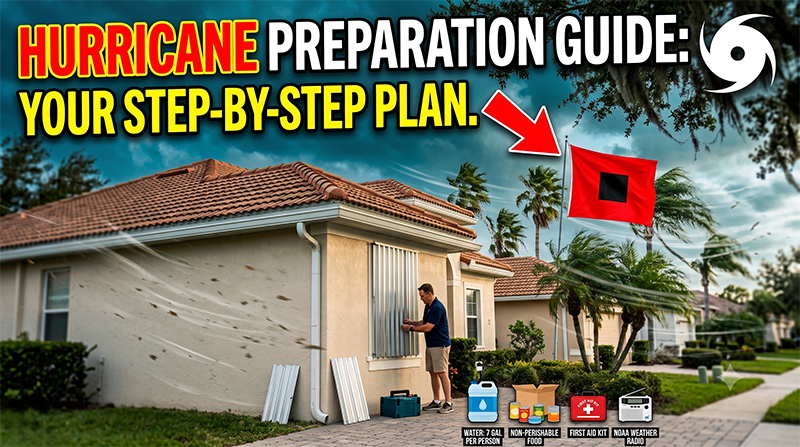
Central Florida homes rarely see storm surge. Most of our area sits well inland, from Winter Garden and Windermere to Clermont, Dr. Phillips, and Ocoee. That does not make hurricane season less serious here. Wind damage causes most of the claims. So do tornadoes spun off from outer rain bands. Flash flooding is a real risk too. Retention ponds fill fast in a slow-moving storm. A few inches of rain in an hour can flood a street before the wind even peaks.
Maybe you bought your home recently. Maybe you have not lived through a direct hit yet. That is a good thing. But it also means your hurricane plan may need an update. Here is what actually matters for an inland Central Florida home in 2026.
| Metric | 2026 Forecast |
|---|---|
| Chance of a below-normal season | 55% |
| Named storms expected | 8 to 14 |
| Hurricanes expected | 3 to 6 |
| Major hurricanes (Cat. 3+) expected | 1 to 3 |
| 30-year seasonal average | 14.4 named storms / 7.2 hurricanes |
What NOAA Is Forecasting for the 2026 Season
NOAA's Climate Prediction Center expects a below-normal Atlantic season this year. The May 2026 outlook puts the odds at 55 percent. Forecasters expect 8 to 14 named storms. Of those, 3 to 6 should become hurricanes, and 1 to 3 could reach major hurricane strength. That is quieter than the 30-year average of 14 named storms and 7 hurricanes. Still, NOAA's National Weather Service Director Ken Graham has a clear message. A quiet forecast is not a reason to skip prep. One storm can still cause billions in damage, no matter what the season average looks like.
Build a Kit to the Florida Standard, Not the National One
Florida's Division of Emergency Management sets a higher bar than the rest of the country. It recommends seven days of supplies per person. The federal minimum is only three. Storms here can knock out power for over a week, especially under heavy tree canopy. Since August 1, 2025, Florida has made several hurricane items permanently tax-free, no holiday required. Use the checklist below as your starting point.
| Category | What to Have on Hand |
|---|---|
| Water and food | 1 gallon per person per day, 7-day supply. Non-perishable food, manual can opener |
| Power and light* | Batteries*, portable generator up to 10 kW*, flashlights, weather radio |
| Safety* | Smoke and carbon monoxide detectors*, fire extinguisher*, first aid kit |
| Shelter and repair* | Waterproof tarp up to 1,000 sq. ft.*, ground anchor kit* |
| Documents and cash | Insurance policy, ID, deed copies in a waterproof container. Cash in small bills |
Download the Printable Hurricane Kit Checklist (PDF)
Not Sure If Your Home Is Storm-Ready?
800-plus five-star reviews and a Zillow Premier Agent team ready to walk you through wind mitigation credits, flood zones, and what your insurance history says about your home.
Harden Windows, Doors, and the Roof Before a Watch Is Issued
Wind is the main threat to an inland home, not surge. Impact-resistant windows do more to protect a house than almost any other upgrade. If new windows are not in this year's budget, storm shutters or marine-grade plywood cover the same gap for less. Do not skip the garage door. A standard door can buckle under wind pressure. Once it fails, air pressurizes the whole house, and that is often what takes the roof off. Florida's My Safe Florida Home Program can help with the cost. It pairs a free wind mitigation inspection with a matching grant of up to 10,000 dollars. Eligible upgrades include roof reinforcement, shutters, and impact windows. To qualify, the home must be a homesteaded single-family house or townhome insured at 700,000 dollars or less. Check current eligibility through the Florida Department of Financial Services before you rule yourself out. Newer construction, like the new build neighborhoods in Clermont, already meets Florida's updated wind codes, which is one more reason those homes tend to hold their value after a storm.
Roof age matters more than most homeowners realize. Florida insurers often require a four-point inspection once a roof passes 15 to 20 years old. Some carriers will not renew a policy without one. If you are planning to sell in the next year or two, get that inspection done early. A roof that fails inspection during hurricane season can stall a sale fast. Buyers now routinely ask for wind mitigation and four-point reports before they make an offer.
Protect Your Documents and Insurance Before the Season, Not During It
Flood insurance almost always carries a 30-day waiting period. Buying a policy once a storm is already forecast will not help you in time. If your home sits in a flood zone, or even just downhill from one, lock in that policy before June. Check your homeowners policy for the wind or hurricane deductible. Florida insurers often set that deductible as a percentage of your home's value, not a flat dollar amount. That can mean a much bigger out-of-pocket cost than most homeowners expect. Walk through your home with your phone and film every room and closet. Save that video somewhere off-site, like a cloud account or a relative's home outside Florida. Keep paper copies of your deed, policy, and ID in a waterproof container, stored above flood level.
What To Do When a Watch or Warning Is Issued
| Hurricane Watch | Hurricane Warning | |
|---|---|---|
| What it means | Hurricane conditions are possible | Hurricane conditions are expected |
| Typical timing | About 48 hours before tropical-storm-force winds | About 36 hours before tropical-storm-force winds |
| What to do | Finish your prep. This is your work window | Prep should already be done. Shelter or execute your plan |
Fill your gas tank early. Stations near evacuation routes run dry fast once a warning goes out. Keep some cash on hand, since card readers and ATMs need power to work. Pick your safe room now, before you need it. Choose an interior room with no windows, on the lowest level that will not flood. If you run a generator, keep it outdoors, far from windows and doors. Generator exhaust is a leading cause of hurricane-related deaths in Florida, and it kills quietly. The most dangerous stretch is often not the storm itself. It is the 24 hours after, when downed lines and unsafe cleanup send more people to the hospital than the wind did.
A Team That Knows What Central Florida Homes Actually Need
The Erica Diaz Team has helped families buy and sell across Winter Garden, Windermere, Clermont, and Davenport for years. Those conversations often cover wind mitigation credits, flood zones, and what a home's insurance history says about its condition. Maybe you are weighing new impact windows before you list with a Winter Garden real estate agent. Maybe you are browsing homes for sale in Winter Garden and want to know a property's flood zone before you make an offer. Either way, our team can walk you through it. With over $700 million in closed sales and recognition from the Orlando Business Journal, we have guided hundreds of Central Florida families through exactly these decisions, storm season or not.
Get a Head Start on This Hurricane Season
From flood zone checks to wind mitigation credits, the Erica Diaz Team helps Central Florida homeowners plan ahead.
Sources: NOAA Climate Prediction Center, 2026 Atlantic Hurricane Season Outlook (May 2026); Florida Division of Emergency Management, Disaster Supply Kit Checklist; Florida Department of Financial Services, My Safe Florida Home Program; Florida Statutes on flood insurance waiting periods. Data current as of July 2026 and subject to change as NOAA issues its updated outlook in August 2026.